How Binaural Beats Work and the Frequency Following Response (FFR) of the Brain
Sound has a remarkable influence on the human nervous system. Music can change our mood, rhythm can influence movement, and certain sound patterns can affect attention, relaxation, and emotional states. One fascinating example of this interaction between sound and the brain is binaural beats.
Binaural beats are widely used in meditation, hypnosis audio, relaxation recordings, and cognitive training tools. They are designed to gently guide the brain toward particular patterns of neural activity associated with states such as relaxation, focus, or sleep.
To understand how binaural beats work, we first need to explore how the brain processes sound and what scientists call the Frequency Following Response (FFR).
How the Brain Processes Sound
When sound waves enter the ear, they are converted into electrical signals by the cochlea in the inner ear. These signals travel along the auditory nerve to several brain structures, including:
- the brainstem
- the inferior colliculus
- the thalamus
- the auditory cortex
During this process, the brain does not simply detect sound. It actively analyzes patterns such as pitch, rhythm, and timing.
One of the remarkable capabilities of the auditory system is that it can synchronize neural activity with rhythmic acoustic patterns. When a sound contains a repeating frequency pattern, neurons in the auditory pathway may begin to fire in synchrony with that pattern.
This phenomenon is known as the Frequency Following Response (FFR).
What Is the Frequency Following Response (FFR)?
The Frequency Following Response is a measurable neurophysiological response in which neural activity in the brain begins to mirror the frequency characteristics of an external sound stimulus.
In simpler terms, when the brain hears a repetitive rhythm or tone pattern, certain neural populations begin to follow or entrain to that rhythm.
This synchronization can be measured using techniques such as:
- EEG (electroencephalography)
- MEG (magnetoencephalography)
- auditory brainstem response recordings
The FFR mainly originates in the brainstem and midbrain auditory structures, although cortical regions also participate in processing rhythmic auditory input.
Because of this entrainment mechanism, sound can influence the dominant oscillatory activity of neural networks. This is one reason why rhythmic sounds are used in relaxation practices, meditation, and certain therapeutic applications.
Binaural beats make use of this natural neural tendency to synchronize with rhythmic stimuli.
What Are Binaural Beats?
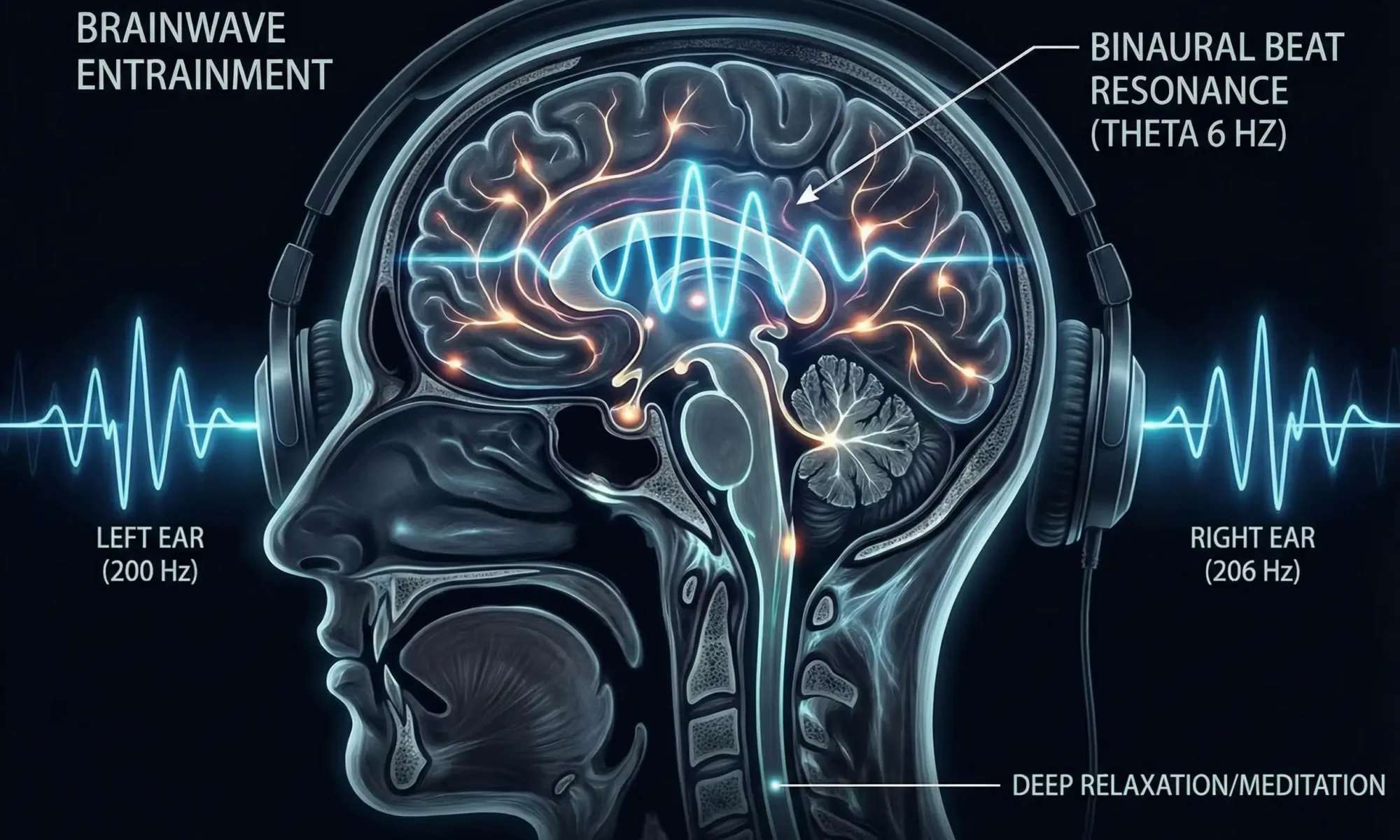
A binaural beat occurs when two slightly different frequencies are presented separately to each ear.
For example:
- Left ear: 200 Hz
- Right ear: 206 Hz
The listener does not perceive two separate tones. Instead, the brain interprets the difference between the two frequencies.
In this case:
206 Hz − 200 Hz = 6 Hz
The listener experiences a subtle rhythmic pulsing at 6 Hz, even though that frequency is not physically present in the audio signal itself.
This perceived rhythmic fluctuation is called the binaural beat.
The effect occurs because the auditory system combines the signals from both ears in structures of the brainstem, particularly in the superior olivary complex, which is responsible for processing differences between the ears.
Why Headphones Are Required
For binaural beats to occur, each ear must receive a different frequency signal. This is why headphones are necessary.
If the tones mix in the air before reaching the ears (as they would with speakers), the physical interference pattern produces a different phenomenon called monaural beats, which is not the same as the brain-generated binaural beat.
With headphones, the brain performs the integration internally, creating the perceived rhythmic beat.
Brainwave States and Neural Oscillations
The brain constantly generates rhythmic electrical activity, often referred to as brainwaves. These oscillations can be measured with EEG and are typically categorized into frequency bands.
Some commonly discussed bands include:
- Delta (deep sleep range)
- Theta (deep relaxation and internal focus)
- Alpha (calm wakefulness)
- Beta (active thinking)
- Gamma (high-level cognitive processing)
These frequency ranges are not rigid states but represent dominant patterns of neural synchronization within large-scale networks of neurons.
Because the brain is sensitive to rhythmic auditory stimulation, it has been hypothesized that binaural beats may encourage the brain to shift toward certain oscillatory patterns through the Frequency Following Response.
Theta Frequencies and Deep Relaxation
One commonly used binaural beat range is theta frequency, typically between about 4 and 8 Hz.
Theta activity is often associated with states such as:
- deep relaxation
- inward attention
- early sleep stages
- meditative absorption
- hypnagogic imagery
Because of these associations, theta binaural beats are frequently used in recordings intended for relaxation, meditation, hypnosis, and creative visualization.
The goal is not to force the brain into a specific state but rather to provide a rhythmic cue that may support the natural transition into a relaxed and internally focused condition.
How the Theta Beat Is Created in Audio
To create a theta binaural beat, two tones with a small frequency difference are presented to each ear.
For example:
Left channel: 396 Hz
Right channel: 402 Hz
The difference between the tones is:
402 − 396 = 6 Hz
The brain perceives a rhythmic modulation at 6 Hz, which falls within the theta range.
This rhythmic perception can then interact with the brain’s Frequency Following Response, encouraging neural synchronization with that pattern.
However, the binaural beat itself is not a physical sound wave at 6 Hz. It is a perceptual effect generated by the brain’s auditory processing system.
Using a Carrier Frequency for Binaural Beats
Binaural beats are usually not presented as extremely low frequencies because tones below roughly 20 Hz fall outside the normal range of human hearing.
Instead, the beat frequency is embedded within two higher audible tones, called carrier frequencies.
The carrier frequency provides the audible base tone, while the slight difference between the tones produces the beat.
In many audio designs, the carrier frequency is chosen from a specific tonal frequency used for the base sound. The binaural beat is then created by shifting one channel slightly above or below that carrier tone.
Embedding a Theta Beat on a Carrier Tone
When designing such audio, the process often works like this:
- A base carrier tone is selected (for example, a specific tonal frequency used as the foundation of the sound design).
- The left audio channel is set to that carrier frequency.
- The right audio channel is shifted slightly higher or lower.
- The difference between the two channels equals the target brainwave frequency.
Example:
Carrier tone: 528 Hz
Left ear: 528 Hz
Right ear: 534 Hz
Difference:
534 − 528 = 6 Hz
The listener perceives a 6 Hz binaural beat embedded within the audible carrier tone.
This approach allows the brain to detect the rhythmic difference while still hearing a comfortable audible tone.
Combining Binaural Beats with Other Audio Elements
In many recordings, binaural beats are not used alone. They are often layered with other audio elements such as:
- ambient soundscapes
- slow music
- environmental textures
- guided hypnosis or meditation
- breathing rhythms
These additional elements serve several purposes:
They create a pleasant listening experience, increase emotional engagement, and support relaxation.
From a neuropsychological perspective, the overall effect of such recordings likely results from a combination of factors, including suggestion, expectation, relaxation, rhythmic sound patterns, and repeated listening.
Scientific Research on Binaural Beats
Research into binaural beats has produced mixed but interesting findings.
Some studies suggest that binaural beats may influence:
- relaxation levels
- perceived stress
- attention and cognitive performance
- mood states
Other studies find minimal or inconsistent effects, suggesting that individual differences, listening conditions, and experimental design play a major role.
In practice, many listeners report that binaural beat recordings help them relax or concentrate, even though the precise neurological mechanisms remain an active area of research.
What is clear is that rhythmic auditory stimulation can influence neural timing, and binaural beats are one way of delivering such rhythms to the auditory system.
Why Repetition and Consistency Matter
Like many mental training tools, the effectiveness of audio-based techniques often depends on regular use.
The brain adapts to repeated stimuli through processes such as neural plasticity, attentional conditioning, and learned relaxation responses.
Over time, listeners may begin to associate certain sound patterns with relaxation or focus, making it easier to enter those states when the audio is played again.
The Relationship Between Sound and Brain Rhythms
The interaction between sound and brain activity is an area of ongoing scientific exploration.
Rhythmic sound patterns—whether in music, drumming traditions, chanting, or modern audio technologies—have long been used across cultures to influence mood and attention.
Binaural beats represent a modern digital approach to this ancient idea: using rhythm and sound patterns to interact with the natural timing mechanisms of the brain.
Conclusion
Binaural beats are created when two slightly different frequencies are presented separately to each ear, causing the brain to perceive a rhythmic beat equal to the difference between those frequencies.
Through the brain’s Frequency Following Response, neural activity may synchronize with this perceived rhythm, potentially influencing relaxation, attention, or meditative states.
When a theta beat is embedded within a carrier tone, such as a specific tonal frequency used as the base sound, the beat is created by shifting one channel slightly above the carrier while keeping the other at the base frequency. The resulting difference produces the rhythmic pulse perceived by the listener.
Although research continues to explore the precise mechanisms involved, binaural beats remain a fascinating example of how carefully designed sound patterns can interact with the auditory system and the rhythmic activity of the human brain.